How Spin Affects a Disc Golf Disc (and How to Get More)
How spin affects a disc golf disc: why it slows turn and fade instead of changing stability, what causes wobble, and how to throw with more spin.
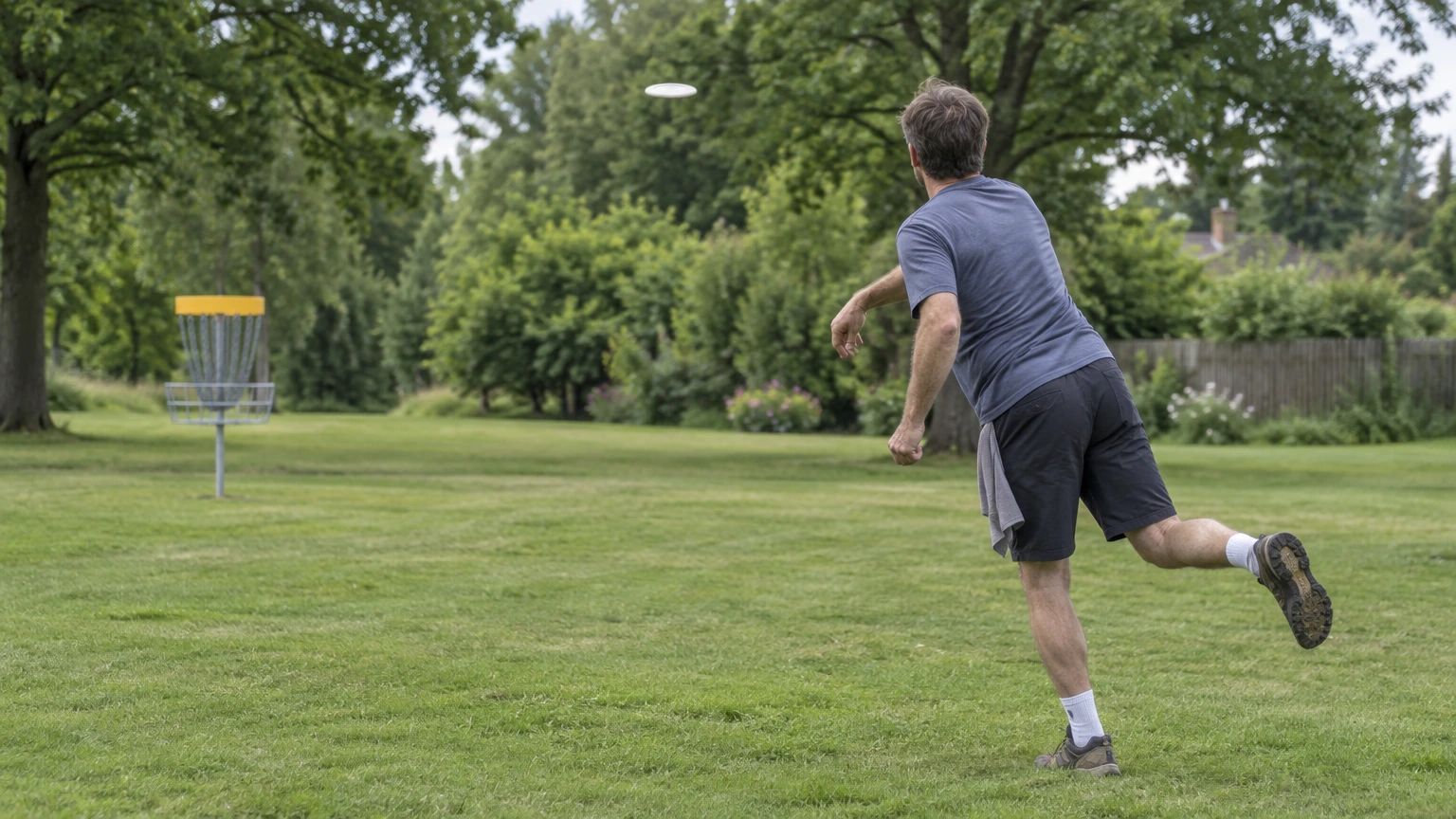
AI-generated illustration
On this page
- What spin does (and doesn’t do) to a disc golf disc
- Why a spinning disc doesn’t flip: gyroscopic stability and precession
- Does spin make a disc more stable?
- Spin vs speed: why the ratio matters more than either number
- Why does your disc wobble? Off-axis torque explained
- How to get more spin on your backhand
- Three ways to test your spin without a sensor
- Spin in the wind
- What Discaddie can measure, and what it can’t
- FAQ
- Sources
The YouTube channel SmarterEveryDay released a video in 2026 that takes a deep dive into the science behind spin and disc golf discs. The video inspired this article, as it sparked an interest in the mechanics behind spin and disc flight. The result is a mix of scientific (and slightly nerdy) information and tips and tricks to generate more spin in your throw.
First of all: How does spin affect a disc golf disc? It keeps the disc steady at the angle you released it on, so at the same speed you get less turn and a softer fade. Wobble comes from off-axis torque at release, not just from too little spin.
The examples below are for a right-hand backhand (RHBH). For left-handers and forehands, flip the directions.
What spin does (and doesn’t do) to a disc golf disc
Spin gives the disc gyroscopic stability. The disc resists changes to the angle it left your hand on, so the air needs more time to tip it into turn or fade. Spin doesn’t create lift, doesn’t change the disc’s stability and doesn’t add distance by itself. What it does is let you throw harder before the disc turns over.
| Effect | Does spin do it? | Sources |
|---|---|---|
| Holds the disc at its release angle | Yes | Disc Golf Avenue, Lorenz |
| Slows down turn and fade | Yes | TechDisc, HyperPhysics |
| Makes wobble settle sooner | Yes | TechDisc |
| Creates lift | No | Disc Golf Avenue, Lorenz |
| Changes the disc’s stability | No | The shape sets the push from the air: Kamaruddin and colleagues |
| Adds distance on its own | No | Our explanation: it lets you use more speed without turning the disc over, and speed is what adds distance |
Why a spinning disc doesn’t flip: gyroscopic stability and precession
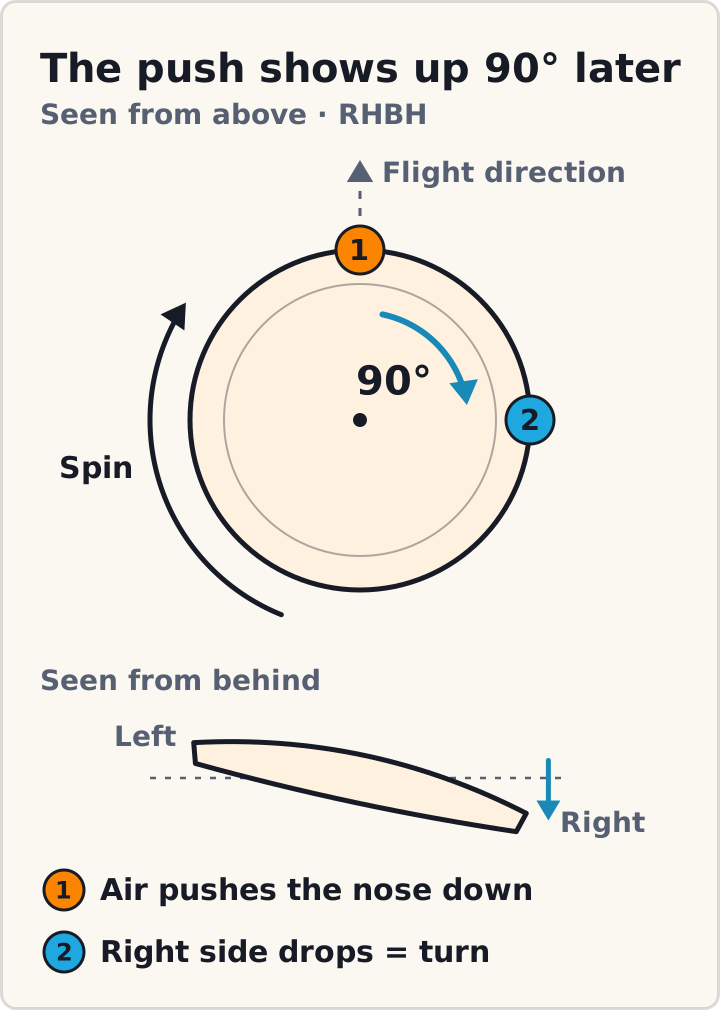
The air doesn’t push evenly on a disc golf disc. The push is a little stronger on one half, which tries to tip the nose up or down. On a spinning disc, the push acts 90 degrees further on in the direction of spin and tilts the disc to one side instead. This is gyroscopic precession, and the tilt is what you see as turn and fade.
The tipping push is called the pitching moment. UDisc explains the same 90-degree rule. Ralph Lorenz’s measurements with an instrumented Frisbee show what it does over a whole flight: the pitching moment slowly turns the spinning disc’s axis, instead of tipping the disc over.
On a RHBH throw the disc spins clockwise seen from above. That gives turn at high speed and fade at low speed:
- High speed, early in the flight. The air pushes the nose down. Ninety degrees further on in the direction of spin is the right side of the disc, so the right side drops and the disc tilts right. That’s turn.
- Low speed, late in the flight. The air pushes the nose up. The left side drops, and the disc tilts left. That’s fade.
The more spin the disc has, the slower the push tilts it. Twice the spin, and the same push tilts it half as fast. HyperPhysics explains the same rule for a spinning top.
Does spin make a disc more stable?
Spin doesn’t make a disc golf disc more stable in the sense of stability ratings and flight numbers. Stability comes from the disc’s shape: how hard the air pushes its nose up or down at a given speed. Spin barely changes that push. It changes how fast the push tilts the disc, so a high-spin throw turns less early and fades softer late.
Wind tunnel tests point the same way. Kamaruddin and colleagues measured how the shape of three disc golf discs changes the pitching moment. Lorenz sums up Potts and Crowther’s wind tunnel tests on a Frisbee like this: “the lift and drag coefficients are relatively insensitive to spin.” Most of this research is on Frisbees, not disc golf discs, so the mechanism carries over, but the exact numbers don’t.
TechDisc writes that more spin gives “a more stable flight, on average”. On the same page they write that spin helps a disc “remain straighter in-flight by resisting turn and fade”, so “stable” there means straighter. A disc that fades hard for you will still fade with more spin. It just does it more slowly.
In your bag in Discaddie, the Chart and Flights tabs show all your discs by their flight numbers, so you see how they should fly on paper. How much of that you see in the air depends on your speed and your spin.
Spin vs speed: why the ratio matters more than either number
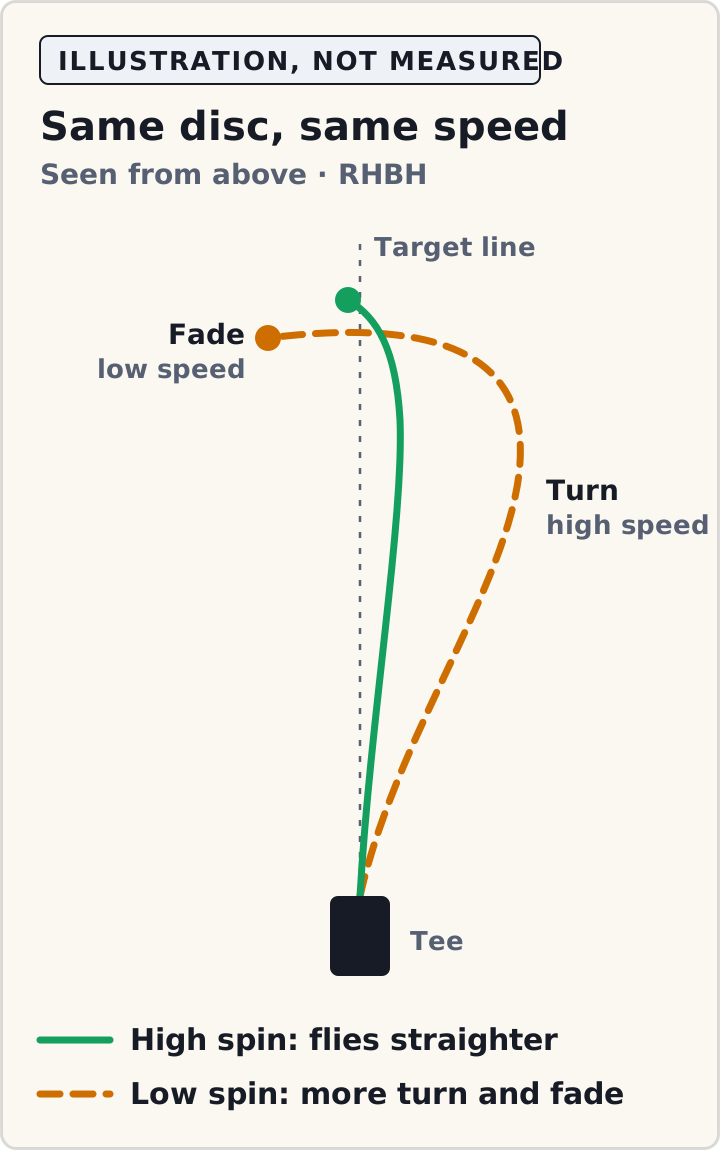
Speed creates turn: at high speed the air pushes the nose down, and the faster you throw, the harder it pushes. Spin slows down how fast that push tilts the disc. What decides the flight is the balance between the two. TechDisc calls it the advance ratio: how fast the rim of the disc moves, compared to how fast the disc flies forward.
What’s a good number? TechDisc’s metrics page says “an Advance Ratio of 50 % is a good target for a backhand throw and an advance ratio of 30 % is a good target for a forehand throw.” School of Disc Golf puts the best ratio for a typical throw “in the mid-40s”. Both are targets from a coach and a sensor maker, not research.
An example with our own arithmetic: a Destroyer is 21.1 cm (8.3 in) across. At 1,000 RPM, its rim moves at about 25 mph (11 m/s). Thrown at 60 mph (97 km/h), that’s a ratio of about 41 %. To reach 50 % at the same speed, it needs about 1,210 RPM.
This is why a disc that flies straight at 80 % can turn over when you throw it as hard as you can. The speed goes up, the spin doesn’t follow, and the ratio drops.
The opposite also happens. A 12-speed driver thrown too slow never gets enough air to turn, so it fades out early and lands short. See why a distance driver doesn’t always go farther.
Why does your disc wobble? Off-axis torque explained
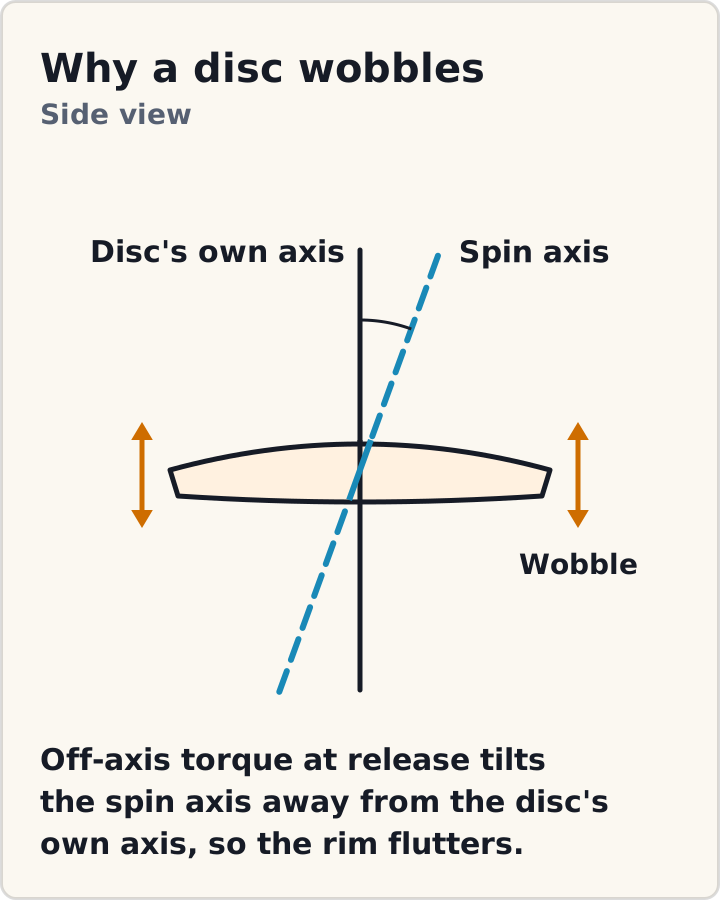
A disc wobbles when it leaves your hand spinning around an axis that doesn’t line up with its own axis. Players call it off-axis torque (OAT): your hand pushes the disc a little off the angle you release it on. Common causes are a wrist that rolls at release, rounding and grip problems. More spin makes the wobble settle sooner.
TechDisc defines wobble as “the Off-Axis Torque applied to a disc during a throw” and writes that a disc with wobble “will appear to flutter in the air before eventually stabilizing”. They also write that wobble adds turbulence, “inducing drag”.
Gotta Go Gotta Throw lists five causes:
- Wrist roll at release. Innova’s Riley O’Neill describes the same thing on a hyzer: the disc wobbles out of the hand and loses spin. His fix is to follow through on the same line as the throw.
- Rounding, where the arm swings in an arc instead of pulling straight across the body.
- Grip that is too tight, too loose or in the wrong place.
- Release point that isn’t in line with the flight path.
- Nose up, which can make an existing wobble worse.
They also write that a wobbling disc behaves “as if it’s more understable than it actually is”. That’s their observation. We haven’t found it measured.
Danny Lindahl goes through off-axis torque in this video on the Dynamic Discs channel.
Forehand wobble has its own causes, mostly in the wrist. We cover it in our forehand article.
How to get more spin on your backhand
Backhand spin comes from the disc ripping out of a firm grip. Keep your fingertips pressed against the rim, keep your hand closed through the hit, and let the disc tear out of your fingers instead of opening your hand to let go. A fast release gives more spin than a slow one with the same arm.
The cue from Inside the Circle is “Don’t open your hand when releasing the disc.” The writer also moved the fingertips onto the corner where the flight plate (the flat middle of the disc) meets the inside of the rim.
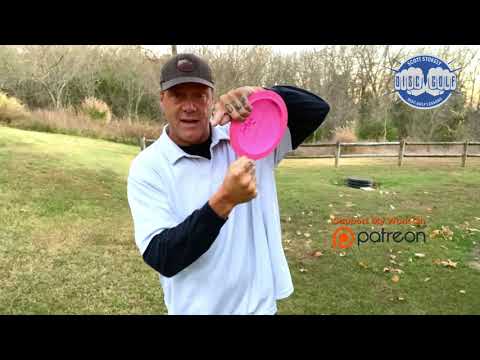
Scott Stokely explains what snap is, and how to build it, in this video from his own channel.
Forehand spin
On a forehand, most of the spin comes from the wrist. Scott Stokely’s three keys to a better sidearm on PDGA.com include “Wrist, wrist, and more wrist”, and he writes that on most throws “more spin is always better than less spin.” Expect less spin than on your backhand: TechDisc writes that the backhand motion “creates more spin than forehand throws, on average”. We go through forehand grip and spin in our forehand article.
Three ways to test your spin without a sensor
You can test spin without a sensor by looking at what spin changes. A standstill putter test shows whether your release is getting cleaner. Ten throws filmed from behind in slow motion show how often the disc wobbles. The same disc thrown at 70 % and full power shows whether your spin keeps up with your speed.
None of the three measures spin directly. They’re our suggestions for seeing the effects of it, and the pass marks are ours too. Write the numbers down the same way as in our field work plan, so you can compare week to week. A spin sensor such as TechDisc measures spin in RPM.
The standstill putter test
How: stand still and throw 10 flat backhands with the same putter in an open field. Measure each throw, by pacing or with a tape, and work out the average. Pick a calm day, and do it from the same spot each time.
The average distance of the 10 throws. Working on your release can help you get a cleaner rip, more spin and less wobble, and this test shows it: if the average goes up and the disc flies flatter, your release has most likely improved, since there’s no run-up to add speed.
The wobble count
How: put your phone on your bag, a few meters behind you, and film in slow motion. Throw 10 backhands with the same disc and the same power.
How many of the 10 have a visible wobble as they leave your hand. Our suggestion is to work on it until it’s two or fewer. Only compare counts with the same disc, power and camera angle.
The speed test
How: pick a stable fairway driver or midrange and a target line, for example a tree far out. Throw 5 flat at about 70 % power, then 5 flat at full power.
How many of each 5 finish right of the line (RHBH). If more go right at full power, your spin isn’t keeping up with your speed. Work at the power where the disc still holds the line, and step up from there.
Spin in the wind
A headwind adds airspeed over the disc, so it acts as if you threw it harder: it turns more. TechDisc makes the same comparison: “Higher Speed affects a disc similarly to a faster headwind.” Spin doesn’t change the push from the wind, but it slows how fast the disc reacts to it. So if you throw harder into a headwind, the spin has to go up too, or the disc turns over.
Riley O’Neill’s wind tips for Innova recommend more power and a more overstable disc into a headwind. He also recommends throwing low and flat, because the wind is weaker close to the ground.
Spin also helps in gusts. Disc Golf Avenue writes that spin “helps the disc resist sudden changes in orientation”, and a gust is one of those.
What Discaddie can measure, and what it can’t
Discaddie doesn’t measure spin, RPM, wobble or arm speed. It measures distance and where your throws land. If you’d rather run the speed test at a basket, the Driving rounds in Practice let you pick Backhand and Straight and count how many land in C1 and C2. Play one round at 70 % and one at full power, and compare.
FAQ
Does spin make a disc go farther?
Not on its own, because spin doesn’t create lift. More spin lets you throw harder before the disc turns over, and a clean release without wobble loses less to drag. So spin adds distance only together with speed. Spin with a slow arm still gives a short throw.
What is snap in disc golf?
Snap is what players call the fast, late release where the disc rips out of a closed hand. It gives the disc both speed and spin from a short motion. Inside the Circle describes the snap sound as your fingers hitting your palm after the disc has left. Scott Stokely’s video above is about how to build it.
Do heavier discs hold their spin better?
A heavier disc spinning at the same speed has more angular momentum, so the air needs longer to tip it. Josef Burger’s notes on disc aerodynamics say: “Faster spin & more weight creates more angular momentum.” The catch is that a heavier disc takes more arm speed to throw. See do lighter discs fly farther.
Why does my forehand wobble more than my backhand?
Most forehand spin comes from the wrist, and a wrist that rolls at release is one of the causes Innova and Gotta Go Gotta Throw describe. TechDisc also writes that a backhand creates more spin than a forehand on average, so a forehand wobble takes longer to settle. The fixes are in our forehand article.
Is a spin putt better than a push putt?
Neither is better for everyone. Altitude Disc Golf describes the spin putt as “like a mini throw” on a flat line that the wind affects less, and the push putt as a slower, arcing toss that is accurate inside the circle. Altitude also describes a middle ground, often called a spush putt. Score both styles from the same distances with our putting drills, and keep the one with more makes.
Sources
- Kamaruddin, Potts and Crowther (2018): “Aerodynamic performance of flying discs”, Aircraft Engineering and Aerospace Technology, 90(2), 390-397. Wind tunnel tests on three disc golf discs.
- Ralph D. Lorenz: “The Instrumented Frisbee as a Prototype for Planetary Entry Probes”, NASA Technical Reports Server. Frisbee, not a disc golf disc. Also the source for Potts and Crowther’s wind tunnel result.
- Potts and Crowther (2002): “Frisbee Aerodynamics”, AIAA paper 2002-3150. Cited here through Lorenz.
- HyperPhysics: “Precession of Top”, Georgia State University.
- UDisc: “What Overstable, Stable, & Understable Mean in Disc Golf”, Alex Williamson, September 25, 2025.
- Disc Golf Avenue: “Why disc golf discs fly differently”. Retailer that sells a spin sensor.
- TechDisc: “TechDisc Metrics”, updated March 19, 2025. Sensor maker.
- TechDisc: “Advance Ratio”. Sensor maker.
- School of Disc Golf: “Unlocking your TechDisc, part 1”, February 29, 2024.
- Gotta Go Gotta Throw: “What Is Off-Axis Torque in Disc Golf?”, May 26, 2026. No sources given.
- Innova: “Common Throwing Errors Holding Back Your Game”, Riley O’Neill, May 14, 2026.
- Innova: “Tips for Playing Disc Golf in the Wind”, Riley O’Neill, June 15, 2023.
- Inside the Circle: “Achieve the Snap in Your Backhand With This One Simple Cue”.
- PDGA: “Three keys to a better sidearm”, Scott Stokely, April 1, 2021.
- PDGA: Destroyer, approved disc specifications. Diameter 21.1 cm.
- Altitude Disc Golf: “Disc Golf Putting Styles”.
- Josef Burger: “Aerodynamics of Flying Discs”, last updated 2010. Personal notes, work in progress.
- GPS.gov: GPS accuracy.
- Scott Stokely: “What is SNAP? How to generate snap in your disc golf game!”, YouTube.
- Dynamic Discs: “Off Axis Torque with Danny Lindahl”, YouTube.