Disc Golf Field Work: How to Practice With a Plan
A simple plan for solo disc golf field work: what to throw, how many reps, how to score each block, and how to see if your throws land closer.
On this page
- Why disc golf field work: it’s hard to learn under pressure
- Pick one focus from your last round
- A 60-minute field work plan
- Field work drills that give you a score
- Why you should mix it up after the first reps
- Measure your throws alone: mark two rings and count
- How often should you do field work?
- Keep a practice log, or you only remember the good throws
- Field work mistakes: no target, too many changes, no plan
- FAQ
- Sources
You throw a stack of discs in a field, pick them up, throw them again, and end your session feeling a mix of emotions. Besides maybe feeling good about a few drives, what did you actually learn? Disc golf field work works better with a plan. This article is meant to help u get started with structured training plans while doing field work.
Why disc golf field work: it’s hard to learn under pressure
On a round you play for a score, and a lot pulls at your attention: the score itself, where you stand against the rest of the card, the hole in front of you, how your body feels that day. That leaves little room for learning. Field work takes all of that away, so you can spend the session learning the throw.
In a field a bad throw is easy to redo. You can throw the same shot 30 times, feel what a clean release is like, and fix one mistake at a time until the disc lands in about the same spot most times. A 200-foot anhyzer approach might come up twice in a round. In a field you can throw it dozens of times and see exactly where each one ends up. It’s also the easiest way to practice disc golf alone, since you don’t need anyone with you.
This article is about accuracy: getting a disc to land close to a target. If you want to know how far you throw, that’s a different session. See how to measure your real distance. Putting has its own plan too: putting drills you can score.
Pick one focus from your last round
Choose what to practice from your last round, not from what’s fun to throw. Think back (or look at your scorecard) and find the throws that cost you a stroke. An approach that left you a 40-footer. Multiple early releases into trees. A forehand you didn’t trust, so you threw a backhand instead.
If two or three of them are the same kind of throw, that’s your focus. The more specific you can be, the better.
One focus per session. You can pick a new one next week.
A 60-minute field work plan
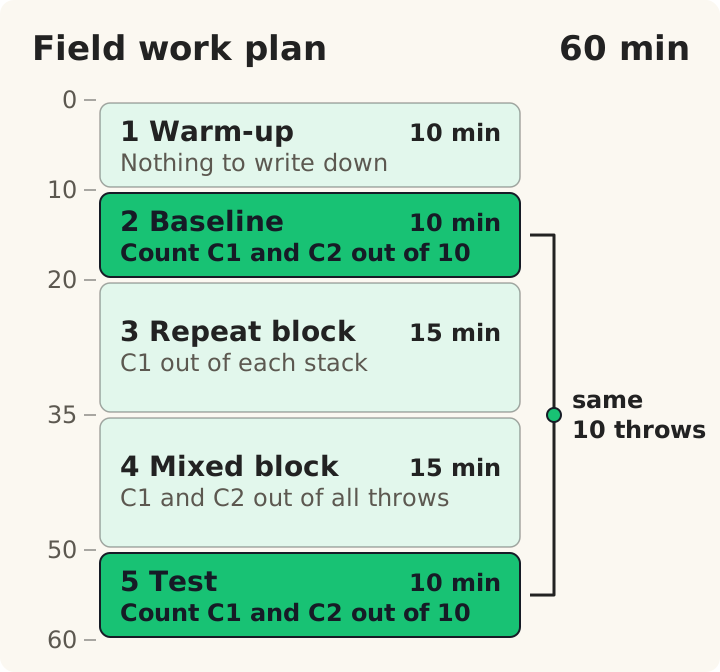
For a 60-minute session we recommend five blocks: warm-up, baseline, repeat block, mixed block and test. The baseline and the test are the same 10 throws, and both times you count how many land within C1 and C2. Compare baselines week to week to see if your throws land closer.
| Block | Minutes | What you do | What you write down |
|---|---|---|---|
| 1. Warm-up | 10 | Easy throws with a putter and a midrange. Start short, build up to the power you use on your focus shot. | Nothing |
| 2. Baseline | 10 | 10 throws of your focus shot, same distance, same line, same disc. | C1 and C2 out of 10 |
| 3. Repeat block | 15 | The same shot, stack after stack, from one spot. Change one thing at a time (release angle, power, disc). | C1 hits out of each stack, and what you changed to be better or worse |
| 4. Mixed block | 15 | Change distance, shape or throw type on every throw. | C1 and C2 out of all throws |
| 5. Test | 10 | The baseline again: 10 throws, same setup. | C1 and C2 out of 10 |
What to bring. A target, 5 to 10 discs of the type you’re practicing, something to mark distances (cones or spare discs), and a pen. A portable basket is the best target. No basket? Use your bag. Stand it upright and measure C1 and C2 from it, exactly as you would from a basket. A cone works too. If your discs are in Discaddie’s disc bag, you can tag each practice throw with the disc you threw, so you know later which mold the numbers belong to.
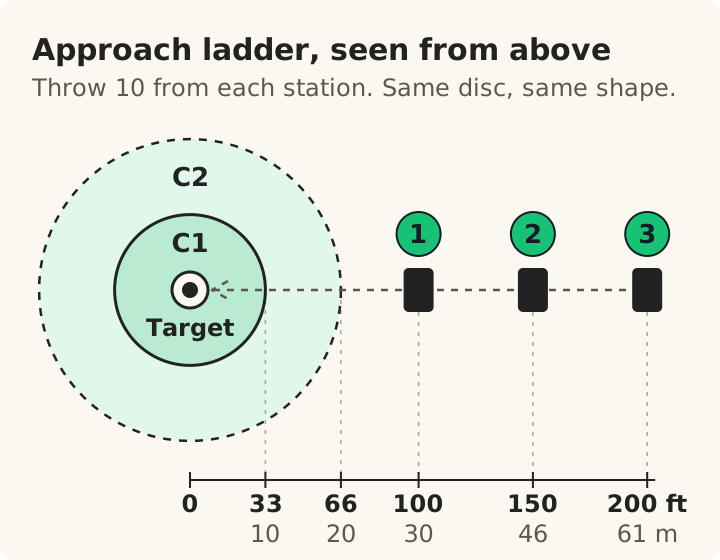
Mark C1 and C2 around the target. C1 is 33 feet (10 m) from the target and C2 is 66 feet (20 m). A few cones on each ring is enough to see where a disc landed. We count C2 as everything within 66 feet, C1 throws included.
Short on time? For a 30-minute session, keep a 5-minute warm-up, the baseline, a 5-minute repeat block and the test. That is 5 + 10 + 5 + 10 minutes.
Don’t expect the test at the end to beat the baseline every time. You’re more tired after 45 minutes of throwing. The more useful comparison is your baseline from one session to the next.
Field work drills that give you a score
Use them in the repeat block and the mixed block of the plan. They all use the same target with C1 and C2 marked.
Discaddie’s Practice mode has separate exercises for driving, approaching and putting. For these drills, use an Approaching session for approach distances and a Driving session for longer throws. Each round in a session has one distance and one shape, so a drill with three stations or three shapes is three rounds.
Paul Ulibarri shows his own favorite field work drill in this video from his channel.

Approach ladder: three distances to one target
Purpose: to find the distance where your approaches stop landing in C1.
How: set up three stations at 100, 150 and 200 feet (30, 46 and 61 m) from the target. Throw 10 from the closest station, then 10 from the middle, then 10 from the farthest. Same disc and same shape for all 30.
C1 and C2 landings out of 10 for each station. If the C1 count drops clearly at one station, that distance is a good focus for the next few sessions.
One line, three shapes: hyzer, straight, anhyzer
Purpose: to find out which shot shape you can trust at one distance.
How: from one station, for example 150 feet (46 m), throw 5 hyzers, 5 straight (flat) shots and 5 anhyzers at the same target. Same disc.
C1 and C2 out of 5 for each shape. The weakest shape is where the next repeat block goes.
Backhand vs forehand at the same distance
Purpose: to see if your forehand is a real option or a shot you avoid.
How: from one station, throw 10 backhand and 10 forehand at the same target. Use the same distance and, if the disc allows it, the same disc.
C1 and C2 out of 10 for each. The gap between the two numbers tells you how much the forehand costs you right now. If you track it for a few weeks, you can see if the gap closes. If the gap is big, Gannon Buhr’s forehand tips break the throw into steps you can practice one at a time. If your forehand turns over or wobbles more than your backhand, read how spin affects a disc golf disc.
Gap drill: hits out of 10
Purpose: to hit a line, not just a landing spot. On a wooded course, that’s most drives.
How: this is Innova’s gap drill, as Riley O’Neill sets it up. Put two cones or discs 10 to 20 feet (3 to 6 m) apart, about 50 feet (15 m) in front of you. Throw 10 discs through the gap. Start with straight shots, then hyzers and anhyzers.
Hits out of 10, per shape. When you hit 8 of 10, make the gap narrower or move the cones farther out.
The mixed block: change something on every throw
Purpose: to practice the way a round works, where no two throws are the same.
How: before you start, write a list of 10 throws with a distance, a shape and backhand or forehand, for example “150, hyzer, BH”. Mix the order. Throw them one at a time, and walk to a new station when the list says so. With only one station, change the shape or the throw type on every throw instead.
C1 and C2 out of 10. Expect a lower number than in the repeat block. That’s normal, and the next section explains why.
Why you should mix it up after the first reps
Repeating one shot many times makes it look good fast. Changing shots between throws makes practice look worse, but in lab studies it often leads to better results later. Start a session by repeating one shot to find it, then mix distances and shapes so the practice looks more like a round.
The idea is called contextual interference. In a 1979 study by Shea and Morgan, people learned three movement tasks, either in blocks (all of one task, then the next) or in random order. The block group did better during practice. The random group did better when they were tested later.
The effect is clearest in lab tasks. A 2012 field hockey study with beginners found no difference between blocked, mixed and random schedules, and the authors point to earlier work showing that support for the effect in applied settings “was not strong”. We don’t know of any study on disc golf.
That’s why the plan uses both. The repeat block helps you find the shot. The mixed block is closer to what a round asks of you, and it gives you a more honest number. So if your mixed score is lower than your repeat score, you haven’t gotten worse.
Measure your throws alone: mark two rings and count
Mark rings around your target so you only have to see which ring each disc landed in. Tie a 33-foot (10 m) cord to the target, or measure once with a tape and put cones on the C1 and C2 lines at 33 and 66 feet (10 and 20 m). For longer distances, pace it, use a rangefinder or use GPS.
A few ways to do it without a partner:
- Cord or cones. The most exact option for C1 and C2. A cord tied to the target lets you check the close calls.
- Pacing. Measure your own step once: walk 10 steps along a tape and divide the distance by 10. Then use that number every session.
- Laser rangefinder. Quick for the distance from where you stand to the target, which is useful when you set up the stations.
- GPS on your phone. Easy, but not exact. GPS.gov says smartphones are typically accurate to within 16 feet (4.9 m) under open sky, and worse near trees and buildings. That’s half the radius of C1, so throws that land close to a ring line can be counted in the wrong ring. Over 10 or 20 throws it evens out a bit, but don’t read much into one throw.
Whichever method you use, use the same one every time. Your numbers are only comparable with your own numbers from the same setup. For measuring distance rather than accuracy, see how far should you throw a disc golf disc.
How often should you do field work?
We’d aim for one or two short field sessions a week, and no more than you can keep up for two months. Short and regular is easier to keep going than long and rare, and your form gets sloppy late in a long session anyway. Surveys suggest most players do less than that.
Some numbers from two Infinite Discs surveys:
- 2017: about 60 % said they practice putting at least once a week, and about 30 % said the same for field work. In the Pro division, “just under half” did field work at least weekly (Infinite Discs’ 2017 survey).
- 2023: in summer, over 75 % of respondents did field work at least once a month, and one in five said they practiced two or more times a week. In winter, just over half did no field work at all (Infinite Discs’ 2023 survey).
The numbers are self-reported, and neither article says how many people answered. A link between practice and division shows that better players practice more, not that practice is what made them better.
Keep a practice log, or you only remember the good throws
Without a log you only have a feeling. Write one row per block, with the date, your focus, the distance, the shape, backhand or forehand, and how many throws landed within C1 and C2 out of the total. Paper in your bag works fine.
| Date | Focus | Distance | Shape | BH/FH | C1 | C2 | Throws | Note |
|---|---|---|---|---|---|---|---|---|
| Oct 2 | Approach | 150 ft (46 m) | Hyzer | BH | 3 | 7 | 10 | Baseline |
| Oct 2 | Approach | 150 ft (46 m) | Hyzer | BH | 2 | 6 | 10 | Test, tired |
| Oct 6 | Approach | 150 ft (46 m) | Hyzer | BH | 4 | 8 | 10 | Baseline |
The numbers in the table are examples, not benchmarks.
A few rules that keep the log useful:
- Count C2 the same way every time. Here C2 means within 66 feet (20 m), C1 throws included. So C2 is always equal to or higher than C1.
- Same setup for the baseline. Same distance, same disc, same target. Change the setup and you can’t compare the rows.
- Look at weeks, not sessions. Wind, a bad night’s sleep or a wet field can move one session a lot. Look at the baseline rows over three or four weeks.
- Write it down right after the block. Numbers you remember later tend to be a little better than the real ones.
Then use the numbers on the course. If your approach ladder shows that C1 drops off past 150 feet, plan the longer approaches to land safely in C2 instead of going straight at the basket. Discaddie’s virtual caddie lets you draw your line on the hole map, see its distance and pick the disc from your bag before the round, so you can plan around the distances your log says you can trust.
Field work mistakes: no target, too many changes, no plan
- Only throwing max drives. Unless drive distance is your focus from the last round, keep distance work to its own session.
- No target. Without a target, there’s nothing to count, and every throw feels about the same.
- Five things at once. New disc, new grip, new footwork and a new shape in one session. When the numbers change, you won’t know why.
- Throwing on after your form is gone. When two stacks in a row get clearly worse and you’re tired, stop or switch to easy putter throws.
- Only practicing the shots you’re already good at. Your weakest shape or throw type from the drills above is usually the one to work on.
FAQ
How many discs should I bring to field work?
Enough that you spend the session throwing, not walking. 5 to 10 discs of the type you’re practicing works for most drills. Use the same mold for the baseline and the test if you can, so your score measures you and not the discs.
Where can I do field work?
Any open, mostly flat area where you can throw without hitting people: an empty sports field, a large park, or a quiet hole on a course on a weekday. Check the local rules first. Some parks and sports fields don’t allow it, and on a course, players on a round always go first.
Is field work better than playing rounds?
They train different things. A round gives you one try at each shot, with the pressure and the variety of real holes. Field work gives you many tries at one shot, so you can change something and see the result. If you want to improve, do some of both.
Should I practice putting during field work?
Putting needs its own basket and its own plan. See our putting drills with scoring, or use the putting challenges in Discaddie’s Practice mode, which count your makes and misses at set distances. If you have a portable basket, 10 minutes of putting after the test block is a good way to end a session.
Sources
- Innova: “How Field Work Can Make You a Better Disc Golfer”, Riley O’Neill, April 2026. Gap drill setup.
- Shea and Morgan (1979): “Contextual interference effects on the acquisition, retention, and transfer of a motor skill”, Journal of Experimental Psychology: Human Learning and Memory, 5(2), 179-187.
- Cheong and colleagues (2012): “Practicing Field Hockey Skills Along the Contextual Interference Continuum”, Journal of Sports Science and Medicine.
- Infinite Discs: “State of Disc Golf 2017: Does Practice Really Work?”, Jace Smellie, March 2017. Self-reported, sample size not given.
- Infinite Discs: “State of Disc Golf Survey: Practice and Play”, Ted Hegemann, March 2023. Self-reported, sample size not given.
- UDisc: Stats definitions. C1, C2 and C1 in regulation.
- GPS.gov: GPS accuracy. Smartphone accuracy.
- Paul Ulibarri: “Uli shares his favorite field work drill”, YouTube.