Gannon Buhr's Forehand Tips: Grip, Angle and Drills
Gannon Buhr's forehand tutorial, broken into steps: a flight plate grip, a simple run-up and one steady angle, plus drills that show if it works for you.

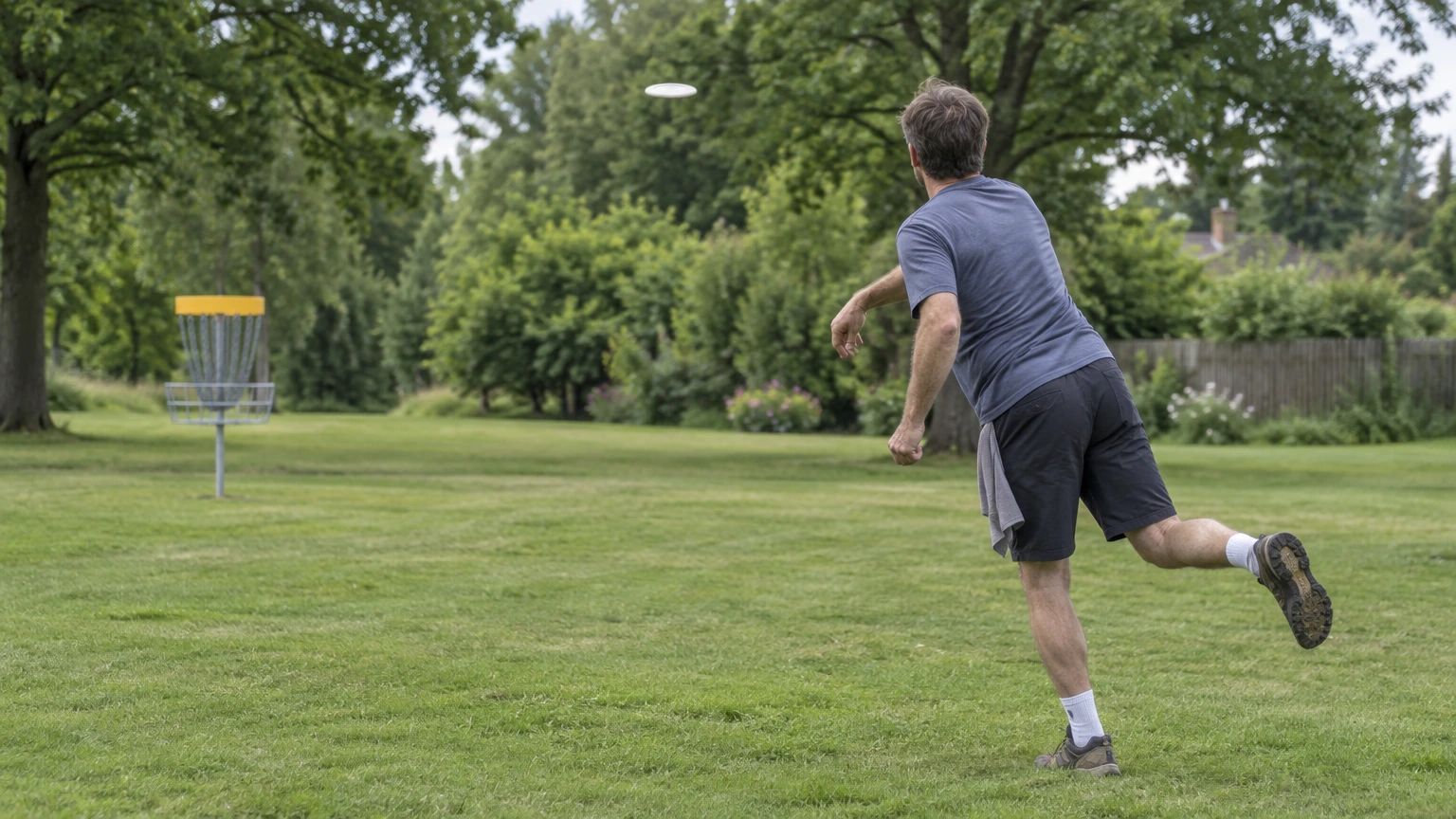
AI-generated illustration
On this page
- Gannon Buhr’s forehand in five steps
- The grip: pressure on the flight plate, not the rim
- A simple run-up: one, two, hop, three, four
- Pick one angle and keep it through the throw
- Elbow to the hip: the flat pull-through
- More power: the left arm and the coil
- How Buhr’s advice compares with other pros
- Common forehand mistakes and how to check them
- Forehand or backhand: when is the forehand the right throw?
- Which discs to learn it with
- Track your forehand in Discaddie
- FAQ
- Sources
Gannon Buhr’s forehand tips come down to five things: put the grip pressure on the flight plate for more spin, keep the run-up simple, hold one angle through the whole throw, drop the elbow to the hip, and add the left arm and the coil last. This guide is based on his public tutorial on his YouTube channel, with drills to practice each step.
Did you know that our putting feature has a drill named after him, Buhr 85?
Everything below describes a right-hand forehand. If you throw left-handed, swap left and right.

Gannon Buhr’s forehand in five steps
We’ve split Gannon Buhr’s forehand tutorial into five steps. The first four keep the throw under control: the grip, the run-up, the angle and the elbow-to-hip pull-through. The fifth, the left arm and the coil, adds power, and Buhr calls it the more advanced part. Learn them in that order.
The table links each step to its spot in the video.
| Step | What Buhr does | In the video | Check it yourself |
|---|---|---|---|
| 1. Grip | Most of the pressure on the flight plate, not the rim | 0:16 | 10 putter throws, count the ones that wobble |
| 2. Run-up | One, two, hop, three, four, throw. Slow and controlled | 0:56 | Your right foot lands where your left foot just was |
| 3. Angle | Leans and sets the elbow height before the throw, then keeps that angle | 1:58 | Film from behind: same angle at reachback and release |
| 4. Pull-through | Drops the elbow into the right hip and keeps it there | 3:32 | The disc leaves on the angle you set up |
| 5. Left arm and coil | Left arm reaches forward and pulls down, hips go forward before the upper body | 4:38 and 5:30 | Your accuracy stays the same when you add it |
The grip: pressure on the flight plate, not the rim
Put most of your forehand grip pressure on the flight plate (the flat middle part of the disc), not the rim. Gannon Buhr does this because a rim grip gives him wobble. Pinching the flight plate lets the disc pivot in his hand without ripping out, which gives more spin. He says spin matters with slower discs.
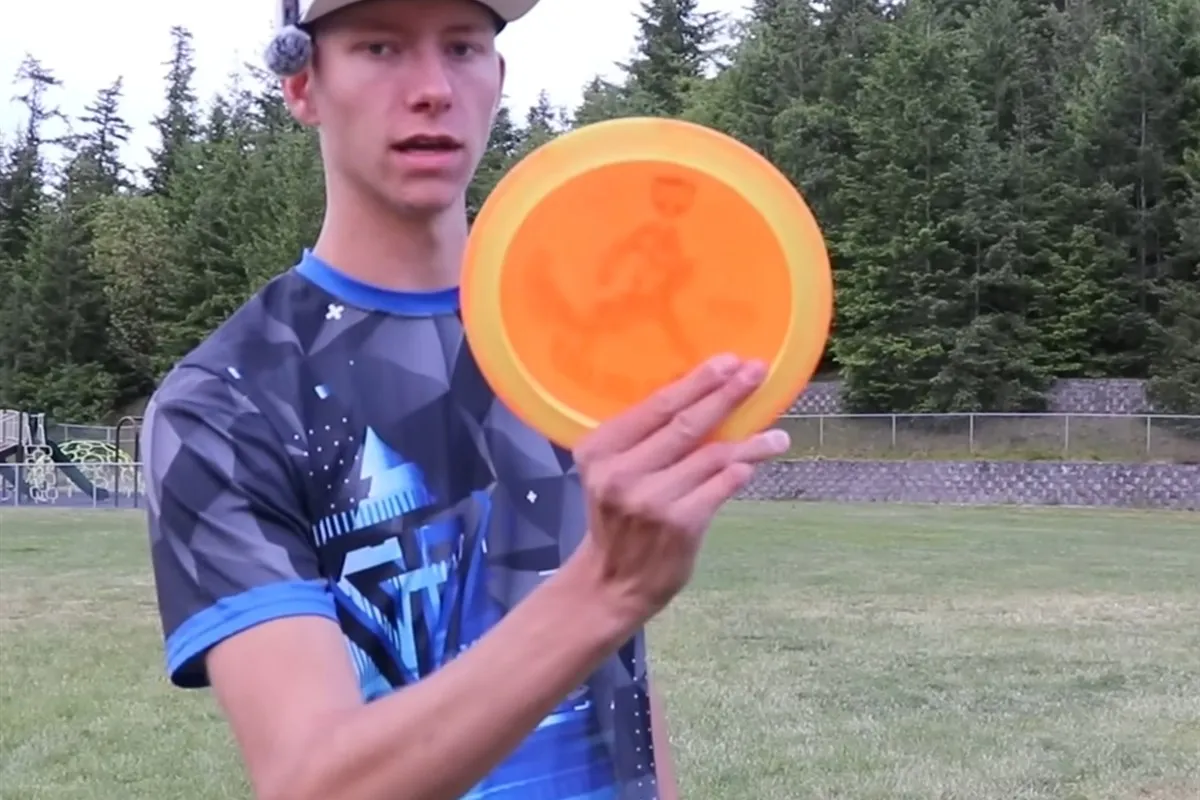
Still from Gannon Buhr’s “How to Instantly Get a Better Forehand in Disc Golf (Tutorial)”, 0:18.
In the still, his fingers lie flat against the underside of the flight plate, in toward the middle of the disc, instead of curling around the rim. He adds that the grip comes down to what feels right in your hand.
Other forehand guides put the pressure on the rim. Nate Sexton teaches two fingers on the rim and no space between the disc and your hand, with comfort first, according to Infinite Discs’ summary of his tips. Innova’s forehand guide tells you to press the pads of your fingers into the rim.
Test it instead of picking a side. Take a putter to a field and throw 10 standstill forehands at 50-100 feet (15-30 m) with your normal grip, then 10 with the pressure moved onto the flight plate. Count the throws with visible wobble in each set. Keep the grip with fewer, and run the same test again a week later before you decide.
A simple run-up: one, two, hop, three, four
The run-up in the video is slow and controlled, and Buhr adjusts it to the length of the shot. The count is one, two, hop, three, four, throw. At 1:14 a disc on the grass marks the spot: his left foot lands just to the left of it, and on the next step his right foot takes that same spot. The right foot replaces the left. It doesn’t cross in front of it or behind it.
He mentions those two other options: stepping across in front (a cross-over) and crossing behind. Crossing behind turns his hips too far away from the target and feels awkward to him. It may give a bit more power, but he goes with the simple version.
To check yours, put a marker disc on the grass and plant your left foot right next to it during the run-up. After the throw, look down. Your right foot should be on about the same spot. If it lands well in front of or behind the marker, or the hop carries you past it, slow the run-up down until it doesn’t.
Pick one angle and keep it through the throw
Set your forehand angle before you throw and keep it until the disc leaves your hand. Gannon Buhr leans and lowers his elbow to the height the shot needs, then pulls back and through on that same angle. Starting high and swinging down changes the angle on the way through, and he says that costs consistency and risks injury.
He says he would rather give up 25 to 50 feet of distance and know where the disc ends up every time (from 1:58). He shows an anhyzer at 2:42, a flat throw at 2:52 and a hyzer at 3:07. For the anhyzer he holds the disc high, at about shoulder height, with the outside edge tilted up. For the hyzer the disc is low, as in the still below.
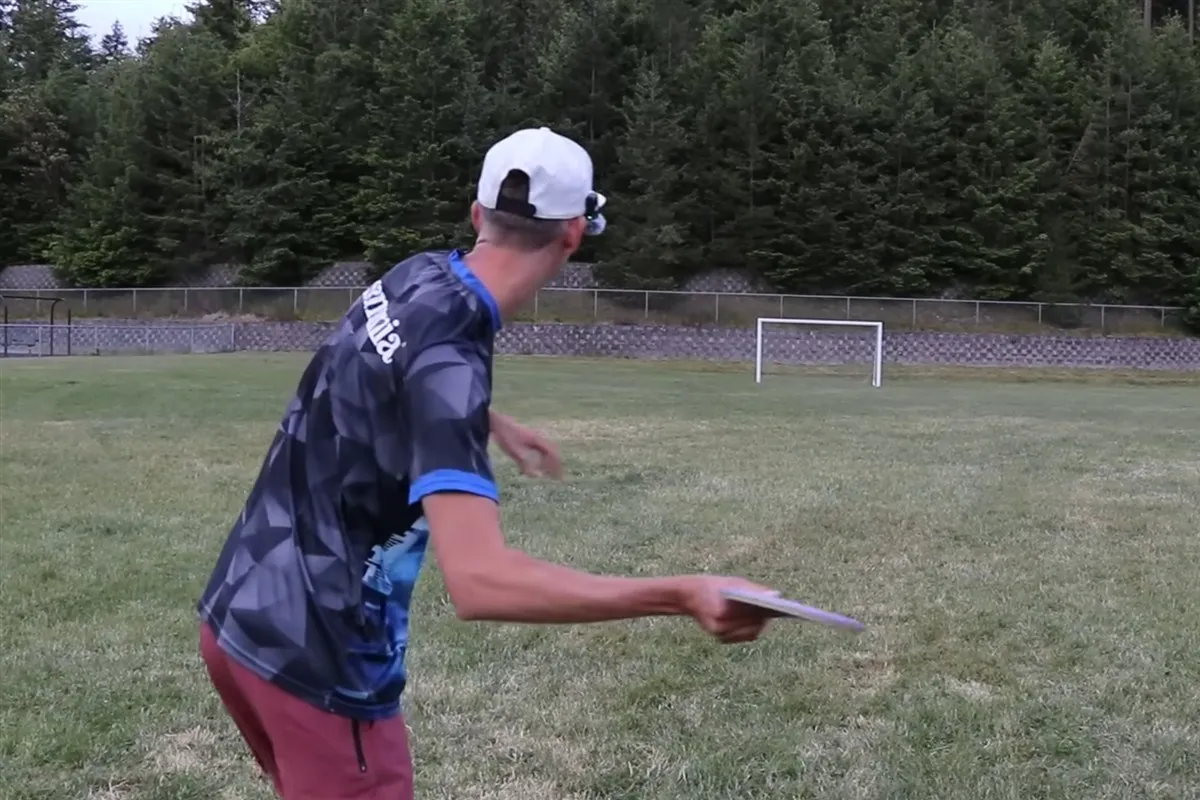
Still from Gannon Buhr’s forehand tutorial, 3:07. The hyzer.
The hyzer still shows how he sets the angle. His upper body leans forward and his elbow is already low, so the disc sits near hip height at the reachback. The tilt is in place before the pull starts, and the arm doesn’t have to swing down into it.
Scott Stokely makes a similar point in his PDGA article on the sidearm. Standing upright, a sidearm comes out at around 15 degrees of anhyzer. To throw it flat, he leans about 15 degrees to the side instead of dropping his arm.
To check your own angle, film yourself from behind with your phone. Pause at the reachback and again at the release. If the disc sits at a different angle in the two frames, the angle is changing during the throw.
Elbow to the hip: the flat pull-through
Gannon Buhr reaches back as his right foot replaces the left. On that last step he lifts his elbow slightly for power, then drops it into his right hip. From there the elbow stays locked for the rest of the forehand, and the disc comes out on the angle he set up. He uses this pull-through as a warm-up for release and timing.
He explains it from 3:32 and throws it at 4:30. The order to feel is: elbow up a little on the last step, elbow down into the right hip, then the disc comes out. If your elbow is still out away from your side when the disc leaves, it never reached the hip.
It also works well as a standstill drill.
More power: the left arm and the coil
Gannon Buhr adds power to his forehand with two pieces he calls the more advanced part of the throw. The left arm reaches forward and pulls down, like a baseball pitcher’s glove arm, to start the spin. The coil means the hips move forward while the upper body is still turned back, so the core tightens and snaps the upper body around.
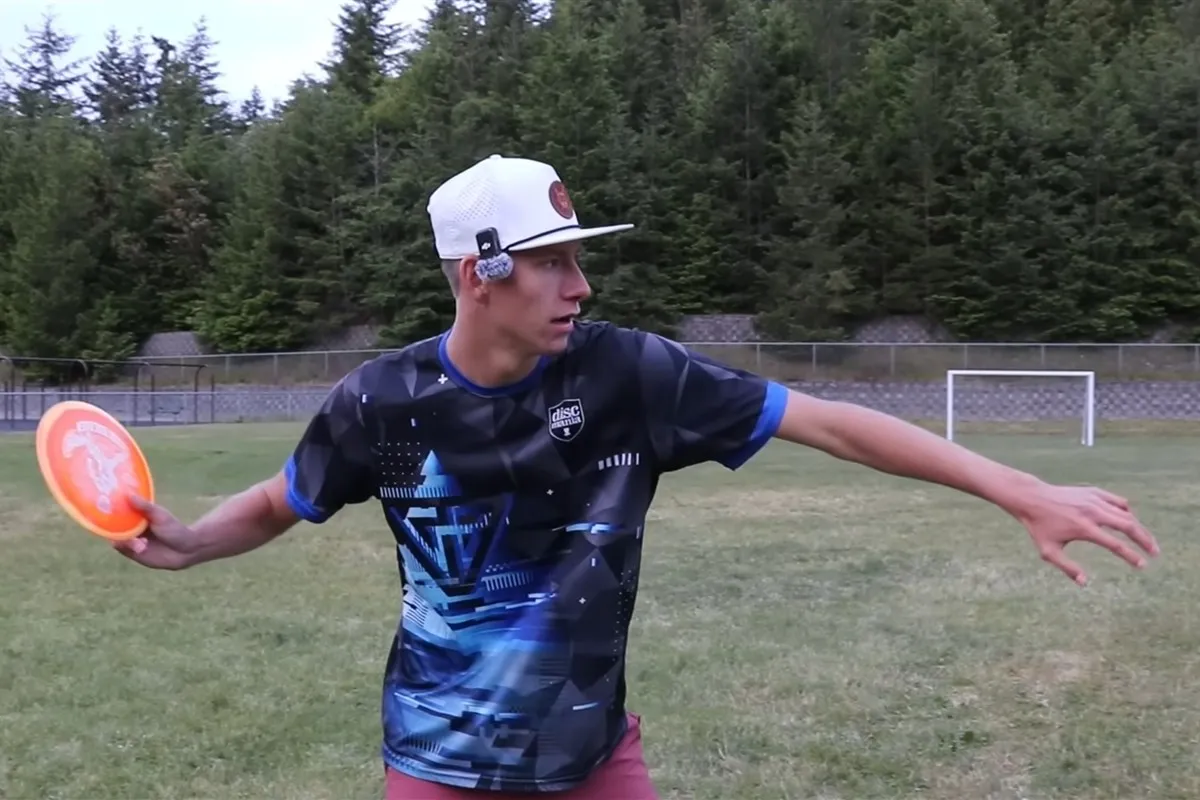
Still from Gannon Buhr’s forehand tutorial, 4:55. The left arm.
In the still, his left arm is stretched out in front of him at about shoulder height while the disc is still back in his right hand. The left arm is out before the right arm starts forward, and pulling it down is what he uses to start the spin. He compares it to the backhand, where the arm also gets going early for spin, and names Anthony Barela as a player who uses the left arm well.
For the coil, the hips go first. Move your hips forward while your chest and shoulders are still turned back toward the reachback. Buhr says you feel it as tension in your stomach and in your back. That tension is the coil, and the stomach muscles then snap the upper body around. At 5:40 he holds his left hand on his stomach while he explains it.
The order he describes is left arm, then right hip, then the right arm comes through and locks. He names Scott Stokely as good at the coil, and Stokely has a forehand playlist on his own channel. Buhr uses the left arm and the early hip when he needs a very long forehand.
How Buhr’s advice compares with other pros
If you watch coverage or regularly play with other people, you may have seen a wide variety of forehand styles. With the forehand throw, different routines and styles work for different people. The most important thing is to find what suits you. We dug through the internet and found a few different ways of explaining the forehand throw.
Gannon Buhr, Nate Sexton, Scott Stokely and Innova’s forehand guide mostly agree on two things: hold your angle, and get the power from the body, not the arm alone. They differ on where the grip pressure goes and on what to do with the elbow. There’s more than one forehand that works, so test the differences yourself.
| Topic | Gannon Buhr (video) | Nate Sexton (via Infinite Discs) | Scott Stokely (PDGA) | Innova guide (Riley O’Neill) |
|---|---|---|---|---|
| Grip | Pressure on the flight plate. Rim grip gives him wobble. Go with what feels right | Two fingers on the rim, no space between disc and hand. Comfort first | Grip firmly, wrist loose | Finger pads pressed into the rim. A comfortable, repeatable grip |
| Angle | Lean and set the elbow height before the throw, keep the angle | Control the angle with wrist, elbow and hip | Upright release is about 15° anhyzer. Lean to throw flat | Keep the palm up after release to hold the angle |
| Elbow | Drops into the right hip and stays locked | Pinned to the side of the body during the hit | Don’t focus on keeping it close to the body | Lead with the elbow |
| Power | Left arm and coil, added last | Wrist speed, not arming the disc | Face forward and turn the upper body for torque | Push off the back leg, rotate the hips, avoid all-arm throws |
| Wrist | Not covered in this video | Active wrist, palm up as long as possible | Loose in the backswing, snap at release | Cock it in the reachback, flick at release |
| Footwork | One, two, hop, three, four | The “Sexton hop”: left, right, hop on the right, throw | Not covered in detail | No single right run-up. It varies from player to player |
The elbow is where they disagree most clearly. Buhr and Sexton both keep it close: Buhr drops it into the hip and keeps it there, Sexton pins it to his side during the hit. Stokely writes the opposite. He says you shouldn’t focus on keeping the elbow close to the body, and calls it a shortcut to spin that people use when the rest of the technique hasn’t been taught. If the elbow-to-hip feeling helps your release, keep it. If you catch yourself squeezing your arm against your side to force spin, that’s the habit Stokely warns about.
We think the most important takeaway here is just that pros have so many different ways of doing it. Find a routine and stick to it if it feels good.
Common forehand mistakes and how to check them
Four forehand problems you can spot in the flight or feel afterward: wobble right after the release, a disc that turns over to the left (for a right-hander), a disc that leaves on a different angle than you set up, and short throws that tire your arm. Each has a quick check you can do in a field with a phone and a few discs.
| Problem | What you see | How to check |
|---|---|---|
| Wobble (flutter, off-axis torque) | The disc shakes in the first part of the flight | Run the grip test from the grip section, then film the release |
| Turnover | The disc banks left and doesn’t fade back, or rolls | Look at your palm at the finish. If it’s facing up and the disc still turns over, check the angle: Stokely notes an upright release already has some anhyzer |
| The angle changes | The disc leaves on a different angle than it had at the reachback | Film from behind and compare two frames. Buhr’s fix: set the angle before the throw, no high-to-low swing |
| All arm | Short throws with little spin, a tired arm after a session | Film from the front: do your hips turn before the arm comes through? |
If your elbow or shoulder hurts, stop throwing forehands. Innova’s guide puts timing ahead of power and suggests lighter discs, less stable molds and a proper warm-up. Sexton warms up gradually before big forehands. Buhr points to the high-to-low swing as an injury risk.
Forehand or backhand: when is the forehand the right throw?
For a right-handed player, a forehand fades right, the opposite of a backhand. That makes it the natural throw on holes that bend right. Innova’s guide adds early obstacles, low ceilings and some wind conditions. Your forehand distance is its own number, so measure it separately from your backhand instead of guessing.
Our distance guide covers measuring both. To see how much the forehand costs you on accuracy right now, the field work guide has a backhand vs forehand drill at the same distance. When you plan a hole in Discaddie’s Caddie, you pick Backhand or Forehand for the throw, and the disc list shows the distance you’ve saved for that throw type.
Which discs to learn it with
Learn it with putters, midranges and understable discs. Sexton recommends understable discs for learning to control angles, and Innova’s guide suggests practicing with putters, midranges and understable discs at different angles, distances and speeds. Buhr’s point about spin fits here: slower discs need spin on a forehand, so a putter at 50-100 feet is a good test of your grip.
We haven’t found a current, first-hand list of the discs Buhr throws forehand, so we don’t list any here.
Track your forehand in Discaddie
FAQ
How do I stop my forehand from wobbling?
Start with the grip and the wrist. Buhr gets wobble when he grips the rim and less when he moves the pressure onto the flight plate. Innova’s guide recommends cocking the wrist in the reachback and flicking it at release. Change one thing at a time, and count the wobbly throws out of 10 with a putter. Why a disc wobbles in the first place, and why more spin helps it settle, is in how spin affects a disc golf disc.
How do I get more spin on my forehand?
Gannon Buhr gets more spin from his grip: he pinches the flight plate, so the disc can pivot in his hand before it leaves. Scott Stokely keeps the wrist loose in the backswing and snaps it at release. Buhr says spin matters with slower discs, so practice it with a putter and count the throws that wobble. What spin actually does to the flight is in our spin article.
Why does my forehand turn over?
For a right-hander, a forehand that turns over drifts left and doesn’t fade back. Check your palm at the finish first. Innova and Nate Sexton both say to keep it facing up. Then check the angle. Stokely notes that an upright sidearm already comes out with some anhyzer, so a flat throw may need a lean.
How do I aim a forehand?
Pick the angle and the line before you start the run-up, and aim with your body instead of fixing it with your arm at the end. Buhr sets the angle by leaning and setting his elbow height, then keeps it through the release. To practice, throw three angles at one target and count how many land within C2.
Should I learn forehand or backhand first?
There’s no fixed order. Holes bend both ways, so you’ll want both throws at some point. If you already throw backhand, start the forehand short: a putter, a standstill, 50-100 feet. Then build it up step by step before you rely on it during a round.
Is forehand the same as sidearm?
Yes. Forehand and sidearm are two names for the same throw. The disc comes from your throwing side with the palm facing up, and it spins the opposite way of a backhand, so it fades the other way. Scott Stokely calls it a sidearm in his PDGA article, while Innova and Buhr call it a forehand.
Sources
- Gannon Buhr: “How to Instantly Get a Better Forehand in Disc Golf (Tutorial)”, YouTube, Gannon Buhr’s channel. The three stills in this article are from this video, with the time under each image.
- Scott Stokely: “Three Keys to a Better Sidearm”, PDGA, April 1, 2021.
- Scott Stokely: “Learn Disc Golf Sidearm/Forehand From Scott Stokely”, YouTube playlist.
- Innova: “Level Up Your Forehand”, Riley O’Neill, March 19, 2026.
- Infinite Discs: “Pro Tips to Improve Your Disc Golf Forehand!”, March 1, 2023. Nate Sexton’s and Ricky Wysocki’s tips.
Discaddie is not affiliated with Gannon Buhr or Discmania.