Throwing up or downhill? How it affects the flight of a disc
Did you ever wonder why throwing up or downhill makes your favorite disc behave differently? This article covers the influence that hills have on your disc.
On this page
- What a hill changes: air time and the angle the disc meets the air
- How does throwing downhill affect a disc?
- How does throwing uphill affect a disc?
- How much longer does an uphill hole play? The 3-to-1 rule
- Which disc to throw uphill and downhill
- Common mistakes on hills
- Planning a hill shot in Discaddie
- FAQ
- Sources
Uphill and downhill disc golf shots fly differently because of where the ground is. The disc itself doesn’t change. Uphill, the ground comes up to meet the disc, so the throw ends sooner and the disc fades before it has flown its normal distance. Downhill, the disc stays in the air longer, so it has more time to turn, more time to fade, and it often skips when it lands. For distance, the PDGA’s rule of thumb is to add 3 feet for every foot the basket sits above the tee, and subtract 3 feet for every foot it sits below.
The examples are for a right-hand backhand (RHBH). For left-handers and forehands, flip the directions. This is about elevation change on the course, not playing at altitude.
What a hill changes: air time and the angle the disc meets the air
A hill changes two things: how long the disc is in the air before it hits the ground, and the angle it meets the air at if you tilt the nose to follow the slope. Downhill gives the disc more time, uphill gives it less. The angle is measured from the line the disc flies on, not from the ground.
Turn and fade come from the angle the air hits the disc at. The Disc Lab explains it like this: “A fast moving disc turns because lift is high which creates a negative angle of attack, a nose down pitching moment, and high speed turn.” When the disc slows down, it loses lift and starts to drop. The air now comes from below, the angle turns positive, the nose is pushed up, and the disc fades. Why a push on the nose ends up as a tilt to the side is gyroscopic precession, explained in our spin article.
The angle of attack is measured against the direction the disc moves: “the angle between the velocity vector and the Frisbee plane”, in Sarah Hummel’s flight model from UC Davis. It’s a Frisbee model, so the mechanism carries over, but the exact numbers don’t.
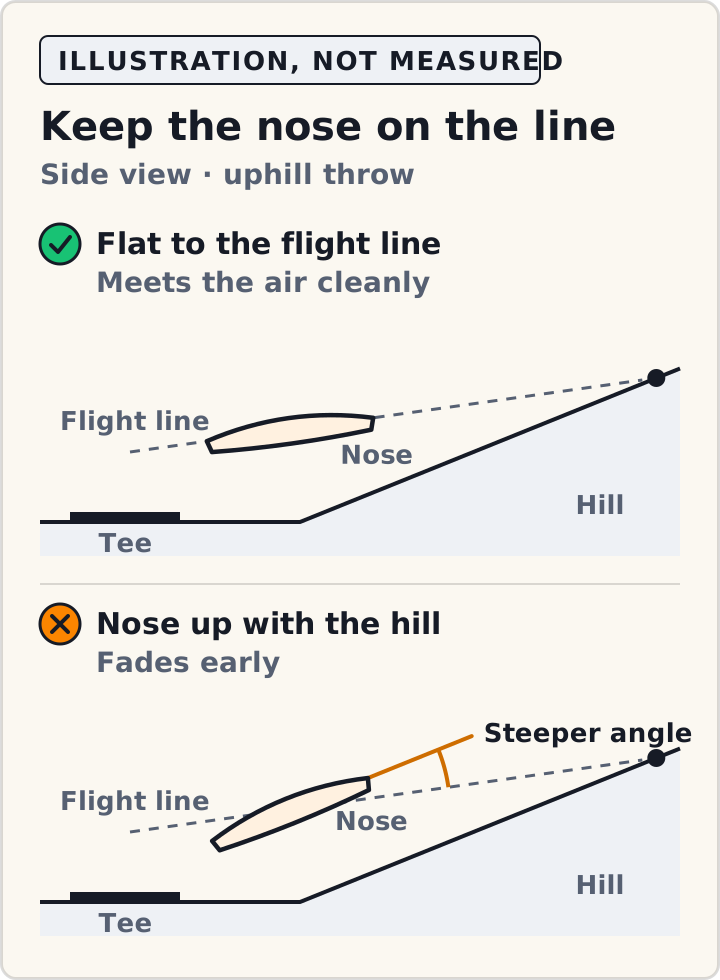
On a hill, a disc released flat to its own flight line meets the air the same way it would on flat ground, even if that line goes up or down. Tilt the nose above or below the line, and the angle changes:
- Nose above the line shows more of the underside to the air. The disc slows down faster and fades earlier.
- Nose below the line gives a more negative angle. The disc turns more.
How does throwing downhill affect a disc?
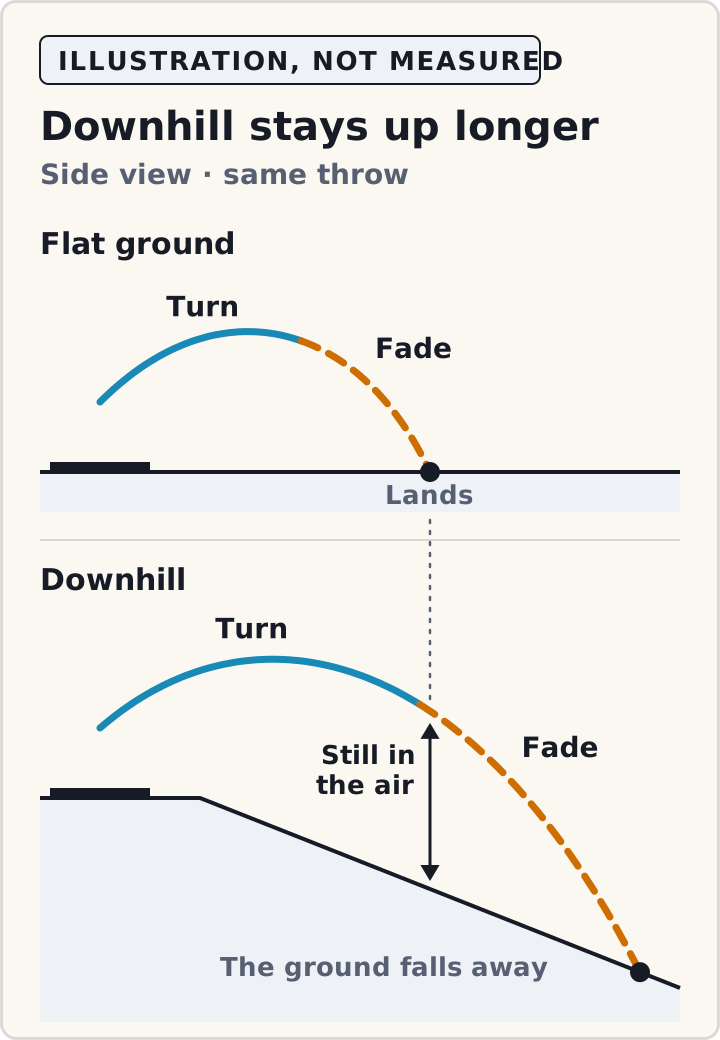
When you throw downhill, the ground falls away under the disc, so it stays in the air longer. It gets more time at high speed to turn, and then more time to fade. Gravity doesn’t make the disc fly faster forward. It just has farther to fall. And when it lands on a slope, it often skips and rolls on.
Inside the Circle writes that gravity’s part “is not disc acceleration, or an increase in speed”. Instead, it makes the disc “slow down less quickly than it normally would”. Andrew Streeter at Sabattus Disc Golf describes the result: “Your disc is going to be in the air longer so it will have more time to flex and more time to fade.”
He also points to the nose. “You’ll also naturally tilt the angle down to match the slope of the hill,” he writes, and recommends “something a little more stable because with nose down anhyzer you won’t want it to flip.” Disc Golf with Jen puts it in player terms: downhill, “your discs will be more understable than usual”. Her fix is a hyzer release, a slightly overstable disc, or both.
Release along the slope, not along the horizon
On a downhill shot, the line you throw on should follow the hill. School of Disc Golf says to “make that line of pull-back and release match the slope of the terrain”, not the flat tee pad you’re standing on. Throw flat like a normal drive, Streeter writes, and “instead of the normal 10-15 foot high drive you’ve thrown a 60 foot high drive.” At that height the wind affects the disc much more (see how wind changes the flight).
So the line goes down with the hill, but the nose doesn’t point lower than that line.
Plan for the landing too. “Downhill shots will skip, and sometimes roll down the hill,” Streeter writes, and his suggestion is to “aim slightly in front of your target and plan for the skip.”
How does throwing uphill affect a disc?
When you throw uphill, the ground comes up to meet the disc, so the throw ends sooner. The disc has to climb, and it reaches the slow, fading part of its flight before it has covered its normal distance. Tilt the nose up to follow the hill, and the disc meets the air at a steeper angle and fades even earlier.
Climbing costs speed. That part is our explanation from basic mechanics, not a measurement: the disc trades forward speed for height, and a slow disc fades. Disc Golf with Jen describes what you see: “When you throw uphill, your discs will act more overstable than they normally do.” Her saying is “hyzers ride, and anhyzers die”. A hyzer rides up the hill, while an anhyzer “is usually going to burn out and not get over the top of the hill”. She also suggests aiming wider than you want, to leave room for the extra fade.
Inside the Circle’s uphill article recommends “a slightly higher release than what you may use when throwing on flat ground”, but warns that “throwing sky high will expose the bottom of the disc to the wind”, which causes early fade and lost distance. Their summary is to keep the nose of the disc down. School of Disc Golf says the same in other words: don’t let the disc hyzer too much, and keep it “somewhat flat.”
So aim a bit higher, and keep the nose on the line you throw on.
On short, steep uphill shots, Inside the Circle suggests leaving the backhand in the bag: “if you’re within 200 feet or so from the basket, and the tree/obstacle cover allows for it, an overhand throw such as a tomahawk or thumber is going to be your best option”. They give the same advice when the slope is too steep for good footing.
How much longer does an uphill hole play? The 3-to-1 rule
The PDGA’s course design guidelines add 3 feet of length for every foot the basket sits above the tee, and subtract 3 feet for every foot it sits below. A 300-foot hole that climbs 10 feet plays like about 330 feet on flat ground. On slopes steeper than 10 %, the PDGA says the multiplier is likely greater than 3.
In the PDGA’s Skill Level Guidelines, the adjustment is calculated “by taking the elevation change, multiplying it by 3, then adding to or subtracting from the hole’s measured length. Add for upslopes, subtract for downslopes.” The PDGA calls the result the hole’s effective length. The same 3-to-1 factor is in the PDGA’s Design Elements and Par Guidelines.
The ratio is the same in meters: a basket 3 m above the tee adds about 9 m. Some examples with our own arithmetic:
| Measured length | Elevation change | Effective length with 3-to-1 |
|---|---|---|
| 300 ft (91 m) | Basket 10 ft (3 m) higher than the tee | About 330 ft (100 m) |
| 300 ft (91 m) | Basket 10 ft (3 m) lower than the tee | About 270 ft (82 m) |
| 250 ft (76 m) | Basket 20 ft (6 m) higher than the tee | About 310 ft (94 m) |
| 300 ft (91 m) | Basket 30 ft (9 m) higher, a slope of about 10 % | At least 390 ft (119 m). The PDGA expects a bigger multiplier on slopes steeper than this |
The rule is made for setting par and designing courses, not for picking a disc on a single throw, so treat it as a starting point. On downhill holes it also says nothing about skip and roll, which can move your disc well past where it first lands.
To use the rule, you need the elevation change. Google Earth on the web shows it: according to Google’s Earth documentation, the altitude in the bottom right corner “updates” as you move the mouse over different locations. Hover over the tee, then the basket, and subtract. Treat it as an estimate.
The rule is most useful when you know your own distance. Measure it on a flat field, then note on hill holes how far short or long you land compared to what 3-to-1 predicted.
Which disc to throw uphill and downhill
The sources disagree because they’re talking about different shots. Downhill to a basket you can reach, you want control: a more stable or slower disc that won’t fly past. Downhill for maximum distance, you want glide. Uphill, you want a disc that doesn’t fade out too early: neutral to understable, with glide.
Sabattus Disc Golf says overstable downhill. Inside the Circle says stable discs in speed 5 to 9 with turn and fade that roughly cancel out, such as 0/0, -1/1 or -2/2. The table shows where each fits. Disc names are the sources’ picks, not ours.
| Situation | What the disc tends to do | What the sources recommend | Why it fits |
|---|---|---|---|
| Uphill, basket within reach | It fades early and lands short, as if it were more overstable than usual. | Understable discs, and lighter discs that “maintain their flight characteristics longer” (Inside the Circle). | An understable disc holds its line longer before it fades, which is the part of the flight the hill takes away. |
| Uphill, long drive | The climb eats speed, so the disc reaches its fade well before its normal distance. | A very understable distance driver: Sabattus describes Uriyah Kelley throwing a Mamba on a long uphill hole, and also suggests the Sidewinder or Roadrunner. | Understable discs “will have time for a full flex” (Sabattus), and if you overturn one, it won’t end up far to the side. |
| Downhill, basket within reach | It stays up longer, turns more, then fades, and it can skip and roll past the basket. | An overstable midrange or putter, such as the Caiman, Zone or Tactic (Sabattus). On holes of 300 feet or less, Streeter throws an Innova Rat flat, lands it short and lets it skip up. | You want the disc on the ground before the basket, not flying past it. An overstable disc fades and drops sooner, so it’s easier to plan where it stops. |
| Downhill, max distance | The extra air time adds distance, but a high, turning disc is exposed to the wind. | Sabattus: a Shryke or Tern with extra glide and some turn, kept low, only when you need 500 feet or more on an open field. Inside the Circle: “even pros will opt for discs that are stable and in the speed range of 5-9”, for example a Buzzz or Mako3. | Our reading: the slope gives a slower disc the time it needs to go far. Tight fairway: the stable mid. Wide-open hill and every foot needed: the driver with glide and turn. |
These are rules of thumb from a retailer and two blogs, not measurements. We haven’t found anyone who has measured how discs fly on slopes. Before a hilly round, the Chart and Flights tabs in your Discaddie bag show which of your discs sit on the understable side and which on the overstable side.
Common mistakes on hills
- Tilting the nose with the hill. Uphill, a nose pointing up fades early. Downhill, a nose pointing down turns over. Keep the nose on the line you throw on.
- Throwing flat at the horizon on a downhill shot. The disc ends up high above the fairway, where the wind has more effect. Release along the slope.
- Aiming at the basket on a downhill approach. Aim short and plan for the skip.
- Picking a disc from the distance on the tee sign. A 300-foot hole that climbs 20 feet plays closer to 360 feet with the 3-to-1 rule. Pick for that length, not the sign.
Planning a hill shot in Discaddie
The Caddie doesn’t know the hole goes uphill. Discaddie has no elevation data: when you draw a line on the hole map, the Caddie measures its length along the map and suggests the three discs in your bag whose saved distance is closest to it.
On a hill hole, add or subtract the 3-to-1 adjustment yourself, then pick the disc under All Discs for the effective length, even if it isn’t one of the suggested ones. Write the elevation change in the plan’s notes, so it’s there next time you play the hole.
One thing to watch: if you run Max Distance in Practice down a slope, your average comes out too long, and when it beats the distance saved for that disc, the app offers to save it to your bag. Say no and measure on flat ground. Otherwise the Caddie’s suggestions will be too long on every flat hole.
FAQ
Should you throw harder uphill?
Throwing harder only helps if your spin goes up with your speed. More speed with the same spin makes the disc turn over, as explained in spin vs speed. Inside the Circle’s uphill advice is “Don’t try to muscle the disc, as this will cause form breakdown.” Use the 3-to-1 rule and pick a disc that reaches the effective length instead.
How do you putt uphill and downhill?
On uphill putts the sources disagree. Disc Golf Puttheads writes that the disc tends to stall and fade left (RHBH), and suggests an understable putter and a bit more pop. Greensplatter writes that a hyzer putt “won’t fade nearly as much when putting uphill” and suggests going straight at the chains. Downhill, both say gravity helps: Puttheads says to “Reduce your power slightly”, and Greensplatter warns spin putters about blow-by. Find out which is true for your putt by playing Around the world on a basket that sits on a slope.
How do you throw on a sidehill?
Land the disc flat. Streeter at Sabattus writes that “If your disc hits the hill at a 90 degree angle, it’s going to roll.” He prefers putters and midranges and matches the throw to the slope: with the high side of the hill on your right, a RHBH hyzer follows the slope, and the whole bottom of the disc lands at once. He also aims “to the higher side of the basket”, because discs “will skip and scuttle slightly down the hill.”
Sources
- PDGA: Course Design Player Skill Level Guidelines. Source for the 3-to-1 rule and the 300-foot example.
- PDGA: Disc Golf Course Design Elements.
- PDGA: Par Guidelines, updated October 6, 2021.
- The Disc Lab: “Disc Turn”, May 10, 2019.
- Sarah Hummel: Frisbee Flight Simulation and Throw Biomechanics, UC Davis. Frisbee, not a disc golf disc.
- Sabattus Disc Golf: “Throwing Discs On and Around Hills”, Andrew Streeter, May 13, 2021. Retailer.
- Inside the Circle: “How to Throw a Disc Downhill”, Broden, July 27, 2021.
- Inside the Circle: “How to Throw a Disc Uphill”, Broden, July 22, 2021.
- School of Disc Golf: “The ‘Ground-Up’ Approach to Saving Strokes, Part 1”, December 10, 2012.
- Disc Golf with Jen: on how elevation, altitude and wind affect a disc’s flight. Only the section on hills is used here.
- Disc Golf Puttheads: on putting with elevation, Rodney Lane, October 30, 2025.
- Greensplatter: on putting uphill and downhill, Taylor Larsen, February 4, 2023.
- Google Earth documentation: “Find basemap imagery dates, altitude, and coordinates”.